Store Locator Plus® continues to upgrade the outdated 2002 style PHP interfaces that were inherited with our WordPress framework to modern React interfaces. Our latest updates focus on replace the mix of old JavaScript and PHP code on the Location Import interface.
Updated locations import interface
Separate Upload / Import Progress Meters
The new interface has a clear separation between the file upload process with its own progress meter and the import processing. The import is designed to separate the file upload process from the file import process. The import process is asynchronous, which means the user can go to other parts of the app to continue working, then come back at any time to the import page and see how their location imports is progressing.
Updated import progres meter.
Sidebar: For smaller files with a couple of hundred of locations this may not seem important. For our customers that are uploading files with 35,000+ locations it is critical that the file upload process is distinct from the processing of the file. While uploads that large can take up to an hour, depending on the user’s connection speed, the import is more challenging. For our customers that do not use our SaaS platform, they can be running on slower smaller web hosting platforms. Importing 35,000 locations will break those servers as they run out of memory or “time out” during the 2-3 hour import process (our SaaS servers are far larger and faster than most self-WordPress sites; if you are doing large location imports you may want to switch to our SaaS platform). The Store Locator Plus® import process manages this by detecting pending timeout issues and keeps track of the current line being imported. If a timeout is imminent the import will stop on the last record processed and queue up a new import request to pick up the process where it left off. That allows the memory and processor to “take a breath” – preventing server crashes and getting those large import files fully loaded without additional user intervention.
Remote File Imports
Remote file location import interface
Remote file imports allow user to load CSV files that are hosted on a different server. This is often used for companies with a separate CMS or inventory management system that exports their locations on a nightly basis to a private URL. The remote file imports can be setup to read those remote files on a regular basis, keeping the list of locations in Store Locator Plus® in sync with external services.
This section now has its own interaction panel with related messages and processing details.
Recent Uploads – new feature
Recent location import files
A new Recent Uploads section allows users to see the list of recent CSV file imports. From here the files can be re-imported (without uploading), downloaded, viewed, or deleted.
Viewing the file shows the details of the most recent import as well as a summary of the first 20 records in the file. To view the complete file, the user can download the CSV file.
Uploaded location file details.
CSV Processing Settings
The shared CSV processing settings are shared between the uploaded CSV, remote processing, and re-import actions. The setting can be accessed via the settings icon on the top right of the Import panel.
Location Import Settings
Load Locations From WordPress
This feature is now part of the Professional and Enterprise accounts and is included in the Import tab as a new section.
This feature allows users to load locations from a WordPress site they own that has the Store Locator Plus® plugin installed.
Our August 2026 user experience updates continue for Store Locator Plus® with a new Cards viewing mode for Locations. The Cards view provides a vertical scrolling column of location cards. This provides a quick view of the location data alongside a map preview to help ensure the location is where you expect it to be.
This feature replaces the SaaS-only Card listing that was in need of a refresh. We opted to include this in the WordPress plugin as well, but be aware this view can use up Google API charges when viewing this mode for users of the WordPress plugin. For the SaaS users, there are no additional charges.
Location Cards Features
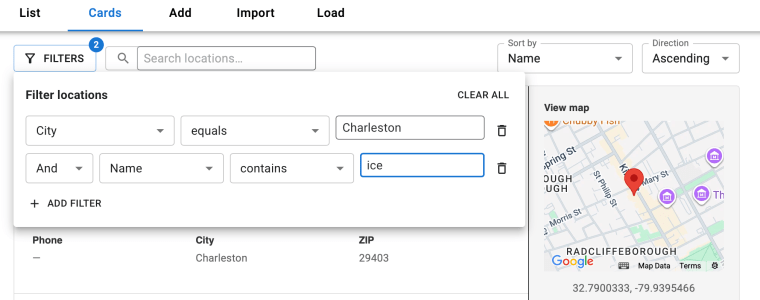
Filter Locations The location cards view provides a filter interface that allows for stacked filter selections to limit the cards that are displayed.
Search Locations The search feature is a multi-field text search that matches full or partial text across multiple location fields.
Both feature mimic the functionality of the new Location List table view that went into production last month.
Location Cards Fitler
Getting the Location Cards
Store Locator Plus® SaaS users will automatically see the new Cards view under the Locations page later this month.
WordPress plugin users will need to update to the latest Store Locator Plus® plugin. Look for the plugin version at or above v2608.04.XX for this new feature. If you’ve not updated the plugin recently you may need to update any associated add on plugins including Power, Experience, and Premier plugins. Keep in mind that all plugins require your WordPress server to be running PHP 8.2 or higher.
We’ve been working on refreshing the existing Locator Styles as part of our 2026 user interface design refresh. Locator Styles provide preset user interface designs for the public-facing side of Store Locator Plus®. The styles provide an easy way to generate a new look for what your customers see on your website when looking for places you sell your wares or provide services.
Our Locator Styles worked well when they were crafted five or six years ago, but they need a refresh to meet today’s interface design standards. We’ve started working through our catalog of pre-defined styles with refreshes that work better with modern themes on WordPress, Wix, Weebly, Shopify and other web presence solutions. The first round of refreshes it meant to upgrade the most popular styles while provide as much backwards compatibility with older web themes.
The good news it that the updated styles are not implemented automatically even if your Store Locator Plus® installation is using one of the Locator Styles we have updated. To try out the revised version of a style you need to select a new style and activate it via the Style Manager in Store Locator Plus® or reload the style if it is already active on your site. With activating a new style or reloading the current style no changes will be made to your installation.
Our revisions for early August 2026 include the Default, Bobbitt, and Bennet locator styles. These updates are now online for most users.
Default Locator Style
The Default locator style is the style that is the default layout everyone starts with. This is designed to change multiple settings back to their initial configuration and provide generic styling that inherits or works alongside multiple web presence themes.
This is the basic layout for Store Locator Plus®. It allows default browser and website themes to dictate the element styling. It has settings that take advantage of Enterprise and Professional level features.
plus… Location categories Search form style, Search by name, Category selection Results header, Prevent result listing wrap, Paginate results, Show country hours and phone, Category icons on results Map styling, hide home marker, map width, map height
plus… Search box placeholder text Map cluster markers, Google map style, map loading indicator
Bennett Locator Style
Bennett locator style, August 2026 revisions as seen in SaaS Preview mode
The Bennett locator style was created years ago for a client with a specific user interface design requested to blend with their website.
Search: Designed to search by category, city, state, tags or the dealer name versus the standard address or zip centric search. Presents the category options as clickable buttons. City and State selectors are via a drop down selection. Tag search and dealer name is a text input. Displays a reset search button to back to the original search with no filters.
Results: Presented as a 4-column design with name, country, phone, and website as the primary output. Gray highlight on hover over location. Light yellow highlight for featured locations.
This theme has been designed to work best with Enterprise subscriptions as it uses cluster markers, table layouts, and scroll map into view features. Category buttons, column result layouts, and other elements require Professional or Enterprise subscriptions.
Bobbitt Locator Style
The Bobbitt style was another customer request.
A yellow color scheme with a simplified search interface. Does NOT show an address search. Focus is on searching by name (if enabled), tags, categories, city, and state.
Results layout shows only the name, address and directions.
Location details are in the map info bubble.
This theme has been designed to work best with Enterprise subscriptions as it uses category search, tag search, city search, and state search features.
More updates are planned for our two-dozen-plus locator styles throughout the remainder of the year. We are also working on creating more advanced interactive styles that go beyond simple layout and styling. Check the Style menu and click the “New…Old” button on the top right of the style stack to see what updates we’ve released most recently.
Note: WordPress users will want to backup their installation to ensure they can recover any settings that may be changed when trying out new styles. SaaS users can review the Settings History to review what was changed and copy settings back as needed. We are working on a “restore previous setting” feature in Settings History to make this easier in the future. Contact us if you need assistance restoring your SaaS styling.